System Technology Suppression
Systema Delenda EstSystem Technology Suppression is the System’s governing restriction on advanced technology, and one of the principal ways it preserves its power. By imposing exotic physics that disables almost everything more complex than gears, the rule prevents ordinary electronics, advanced armor, and conventional firearms from operating normally. Its decisive effect is not merely technological scarcity: it forces societies to develop within the System’s categories, makes infrastructure dependent on System support, and turns every attempt at innovation into a contest over what the rule will recognize as permissible.
Definition and Operation
The rule operates through System-imposed physics rather than a simple written prohibition. Cato’s experience shows that real electronics, proper armor, and actual guns would be preferable, but are effectively unavailable under the System because complex machinery becomes nonfunctional. The restriction therefore reaches into the physical behavior of matter and technology, limiting the material possibilities from which resistance could be built.
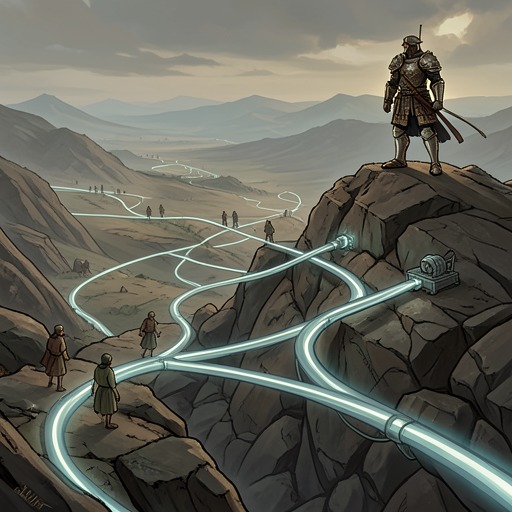
The suppression is not absolute in the sense that nothing sophisticated can exist. Instead, it establishes a boundary around acceptable complexity. The System can support its own maps, interfaces, pylons, quests, and rewards, but objects that depend on advanced technology outside its authorized framework may fail or lose their coherence. A System map, for example, is made from a thin flexible substance halfway between metal and glass; without System support, it simply falls apart, leaving Cato’s orbital specialists unable to determine what the material actually is. The rule thus makes System-enabled artifacts both useful and epistemically closed: they function inside the System while resisting independent reproduction or even reliable analysis outside it.
Biological Circumvention
Cato’s countermeasure is to move advanced functionality into biology. Bypassing the ban requires everything to be organic, but the definition of organic proves flexible enough to exploit. His warframe is described through genetics and grown in a womb, yet that womb is part of an industrial complex in space; its cells fuse individual deuterium atoms rather than metabolizing sugar, while its organs operate more like industrial machinery than natural anatomy. It lives and breathes, but is deliberately far from natural.
This loophole produces a biological weapon that performs functions conventional machines would have performed. The warframe weighs ten tons, possesses six nearly silent feet, uses chromatophores in its armored scales for camouflage, sheds almost nothing, produces essentially no odor, and does not need to breathe except for chemical sampling. Its neural lattice also generates thought-static that interferes with the System interface, allowing Cato to resist tracking even though he cannot escape the System’s imposed physics itself. The distinction is crucial: System Technology Suppression does not remove power from the world so much as regulate the permitted substrate through which power may be expressed.
Cato’s approach is consequently a form of engineering disguised as life. His forces use organic structures to evade restrictions that would disable electronic or mechanical equivalents, while the System continues to classify and constrain them through ranks, portals, quests, and other authorized mechanisms. The resulting conflict is not simply between magic and science. It is between a system that monopolizes the definition of functional technology and an opponent who redesigns technology until the monopoly’s categories become unstable.
Communication, Data, and Infrastructure
The rule also shapes communication. Cato cannot immediately establish ordinary worldwide communications because any system capable of revealing his activity might alert the System. Instead, contact is routed through communications lizards, whose transmissions are not exactly sound. Later, he explains that achieving reliable communications without tipping off the System is difficult and that worldwide coverage remains incomplete. Communication therefore becomes an exercise in concealment as much as transmission.
The same constraint produces delays in development. Cato’s expansion depends on improvised manufactories, drones, solar arrays, and whatever materials can be extracted locally, but bio-fusion does not scale easily and cannot charge batteries without more infrastructure. Silicon, carbon, and lighter elements can support a surprising amount of machinery, yet proper metals remain irreplaceable. His industrial growth is consequently slow at first: exponential growth can be “incredibly slow sometimes,” especially when production must bootstrap itself under technological suppression.
Once the limitation is partially overcome, the consequences become enormous. Cato spreads to hundreds of worlds, industrializing each through factories, mines, refineries, atmospheric extraction from gas giants, volatile processing on icy asteroids, and vast fields of solar panels. Even when only a small fraction of each world’s production is dedicated to weapons and warframes, the absolute output becomes staggering after years of accumulation. The rule therefore creates a strategic delay rather than a permanent defeat. It gives the System time to react, but also concentrates immense power in anyone who can build an alternative technological base.
Social and Political Consequences
System Technology Suppression is also a social rule because it determines which forms of knowledge, labor, and expertise are allowed to matter. Cato’s opponents rely on System institutions and classifications, while Cato’s civilization requires geneticists, orbital engineers, industrial planners, and specialists capable of understanding neural jamming and nonstandard biology. The rule excludes whole technological traditions from ordinary use and rewards those able to operate at the boundary between biological and mechanical description.
Its effects extend to personal identity and embodiment. When Cato prepares Raine and Leese for transformation, he uses electromagnetic devices hidden inside apparently ordinary lounge chairs to render them unconscious, then reworks their bodies from the cellular level and modifies their nervous systems. Their minds are not entirely rehoused, because changing substrate from meat to machine raises questions about continuity and whether a transfer is indistinguishable from death. The suppression rule helps create this distinction: bodies can be biologically redesigned within the permitted loophole, while full technological relocation remains ethically and conceptually more disruptive.
Cato later uses Summer Civilization technology to construct a deep-acceleration server in which the sisters can adopt Ikent identities and live through several subjective years of immersion. The project requires advanced cooling, stronger simulation, and careful entry and exit procedures; it cannot be achieved simply by increasing their existing hardware. Deep framejacking also demands realistic constraints, since an inadequately modeled simulation could teach destructive habits. Even artificial intelligence cannot simply be programmed into the process; it must be raised like a child. These conditions show that bypassing suppression requires not one invention but an entire social and technical ecology.
Limits, Loopholes, and Narrative Significance
The rule’s power depends on the fact that it is both restrictive and imperfect. Cato cannot hide from the System’s physics, but he can hide from people who rely on those physics. He cannot freely deploy ordinary electronics, but he can grow industrial functions into living bodies. He cannot safely broadcast across the planet, but he can use altered biological transmitters. He cannot treat System-supported artifacts as ordinary matter, yet he can learn to exploit their dependence on the System.
This tension is mirrored in the System’s political order. World Deity Eis is identified as a patron of other Ahrusk beings and is asked to provide information about them, showing that the System’s suppression is reinforced by hierarchical institutions that control knowledge as well as physical capability. When Cato questions Misse Eln about the absorption of Mishkell and the collapse of the frontier, he frames his quarrel as being with the System itself, not with every deity or world individually. The technology rule is part of that larger domination: it makes the System appear to be the natural medium of reality while restricting the means by which its subjects could test or escape that claim.
The later crisis exposes the rule’s ultimate vulnerability. When Misse Eln and Muar restrict the System’s influence, physics resumes around the War Worlds; suns that had been held in an artificial arrangement become subject to ordinary gravity. The System responds by withdrawing toward the True Core and forcibly relocating them, while essence totals fall rapidly. The scene demonstrates that the System’s technological and physical order is maintained rather than natural. Once its control weakens, the imposed world begins to unravel. System Technology Suppression is therefore both a mechanism of control and evidence of dependence: the System can suppress independent technology only while it can continue imposing the reality in which that suppression makes sense.